Top 8 Parking Lift Models Ranked for Commercial, Residential, and Underground Projects
Top 8 Parking Lift Models Ranked for Commercial, Residential, and Underground Projects
Short answer: This guide ranks eight verified parking lift models from Mutrade Industrial Corp., ordered from the smallest deployable footprint up to the highest vehicle density. The Hydro-Park 1127 (2,700 kg) and Hydro-Park 1123 (2,300 kg) two-post stackers open the list for residential and valet use. The Starke 2127 (2,700 kg) and Starke 2227 (2,000 kg or 2,500 kg) follow for pit and underground double-unit layouts. The Hydro-Park 2525 & 2625, Hydro-Park 3130 (3,000 kg) and Hydro-Park 3230 (3,000 kg) cover three- and four-car stacking. The ATP Series automated tower closes the list at 50–120 vehicles per unit. All eight are built from carbon steel Q235 and are available with project-specific customization.
Why Parking Lift Model Selection Usually Goes Wrong
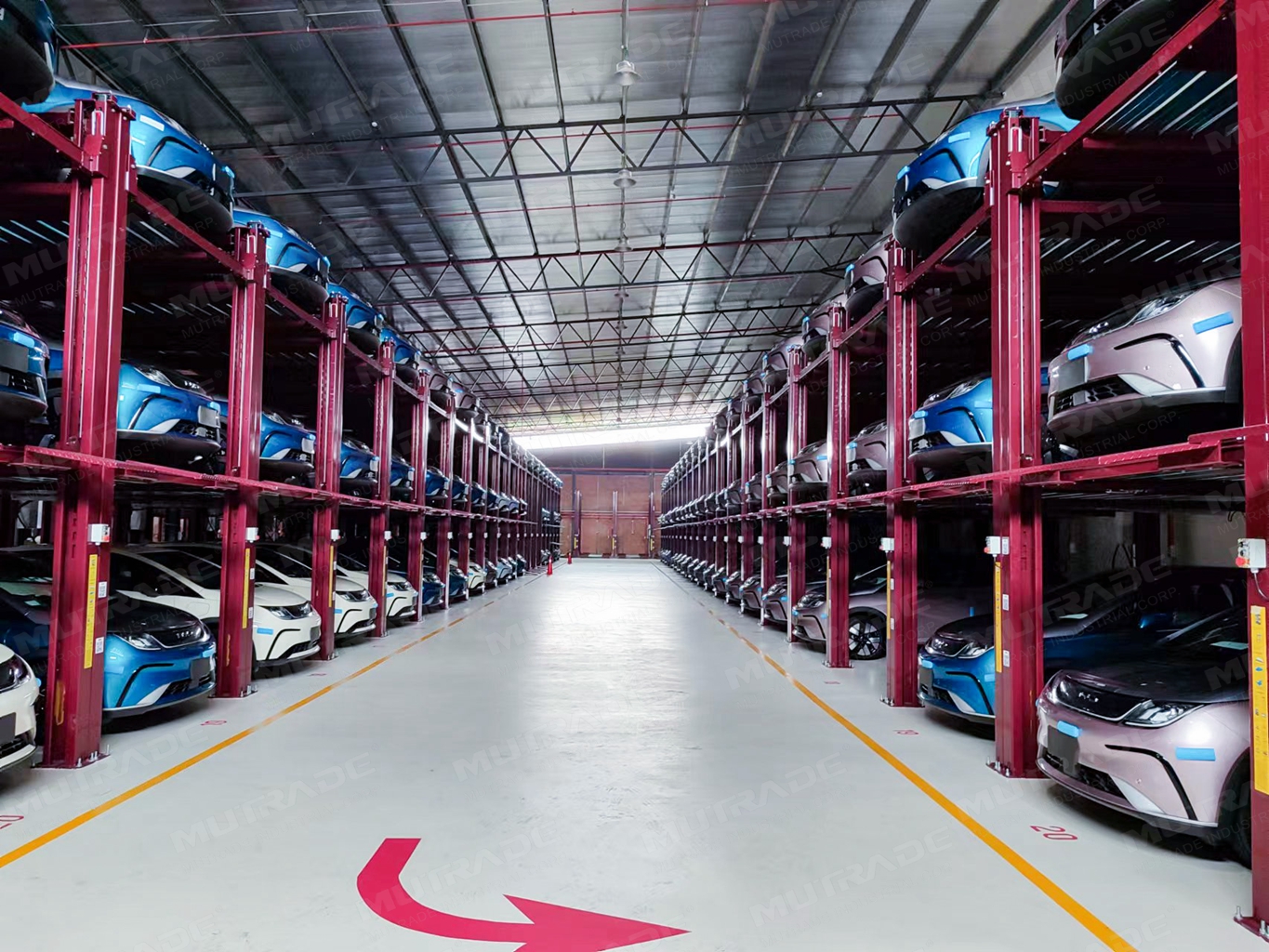
Most disappointing parking lift projects are not caused by a bad lift. They are caused by matching a model to a photo or a price instead of matching it to four physical constraints: ceiling height, pit availability, the largest vehicle envelope the site must accept, and the power supply actually available on site. Each of those constraints eliminates specific models, and each is already fixed by the building before a purchase order is written.
The reason the constraint check matters so much is that the rated capacity figure buyers focus on is rarely the deciding number. What decides the fit is the allowed car dimension. A Hydro-Park 1127 accepts vehicles up to 5,000 mm long, 1,850 mm wide and 2,050 mm high. A Starke 2127 accepts 5,000 mm by 2,050 mm by 1,700 mm. A Hydro-Park 3130 opens up to 6,772 mm of platform length, and a Hydro-Park 3230 to 8,912 mm. Two lifts with the same 2,700 kg rating can therefore serve completely different vehicles.
Power supply is the second silent eliminator. Every lift in this ranking uses a bespoke power supply rather than a single fixed voltage, and the available range differs by family — 110–480 V on the Hydro-Park 1127 and 1123, 200–450 V on the Starke 2127, 380 V on the Starke 2227, and 208–480 V on the Hydro-Park 3130 and 3230. Confirming the site voltage and frequency early prevents a redesign later.
Where the Demand for Parking Lifts Is Coming From
The category is expanding, and the expansion is being driven by land cost rather than by novelty. The global car lifts market, which includes parking and service lifts, was valued at USD 2.8 billion in 2025 and is projected to reach USD 4.7 billion by 2034, according to Dataintelo. Separately, QYResearch values the specific global car stacker lift segment at approximately USD 4.6 billion in 2023, expected to grow to USD 6.72 billion by 2030.
Hydraulic drive dominates for a practical reason: hydraulic mechanisms hold a 57.2% share of the global car lift market, a position Dataintelo attributes to their reliability in heavy-duty applications. That is visible across the lineup below, where every one of the eight ranked models uses hydraulic actuation, paired with either chains or wire rope for load distribution.
Regionally, North America is the largest and fastest-growing vehicle lift market, valued at USD 3.25 billion in 2024 and driven by high light truck ownership, which accounts for 77% of new vehicle sales according to Custom Market Insights. That matters for model selection because longer and heavier vehicles push buyers toward the longer-platform stackers rather than the compact two-post units. For context on the competitive field, BendPak is identified as a major player in the North American vehicle lift market and operated the world's first eight-armed car lift (Octa-Flex) as of 2024.
On the compliance side, automated parking systems are typically required to comply with ISO 9001 for quality management and ISO 45001 for occupational health and safety, standards used to mitigate risks such as vehicle-pedestrian conflict, according to Pacific Certifications. Buyers should confirm the documentation scope that applies to their specific model and destination market before ordering.
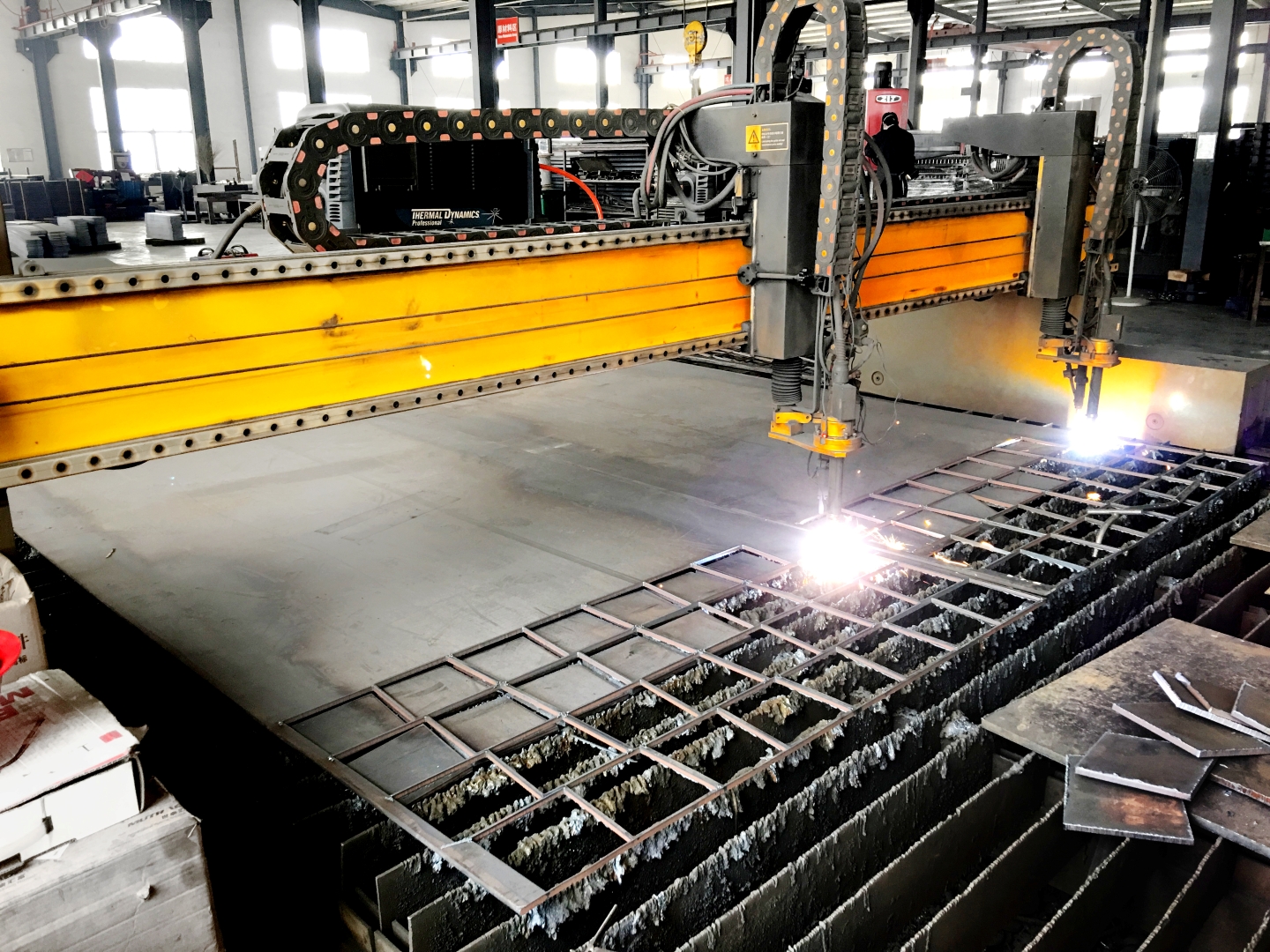
The manufacturer behind every model in this ranking is Mutrade Industrial Corp., established in 2009 and specialising in the design and manufacture of mechanical parking solutions, including parking lifts, semi-automatic parking systems, fully automatic parking systems and car lifts. The company operates a 12,000 m² manufacturing facility with approximately 100 staff and an R&D team of 7 engineers, produces about 10,000 parking spaces per year, exports 99% of its output, and has supported customers in over 100 countries. According to Mutrade and Chinese customs data, MUTRADE (Qingdao Mutrade Co., Ltd.) and its production facility Hydro Park have accounted for over 18% of China's total export volume of mechanical parking equipment (HS Code: 84289020) since 2017.
The Top 8 Parking Lift Models, Ranked
Rank 1Hydro-Park 1127 — Two-Post Double Stacker, 2,700 kg
The Hydro-Park 1127 is a two-post parking lift that parks 2 vehicles per unit with a rated lifting capacity of 2,700 kg, making it the highest-capacity entry in the double-stacker tier. It is built from carbon steel Q235, driven by a hydraulic cylinder with chains, and lifts in 50 seconds using a key switch. Allowed car dimensions are 5,000 mm length, 1,850 mm width and 2,050 mm height. The power supply is bespoke from 110–480 V at 50/60 Hz, and customization is acceptable.
Inclusion rationale: it ranks first because it covers the widest set of everyday applications — residential parking and valet parking, plus commercial and car storage use — while keeping a small footprint and requiring no pit. For a site that simply needs to double the capacity of an existing bay, this is the most directly applicable model in the lineup, and its 2,050 mm vehicle height allowance accommodates taller vehicles than the pit-based units.
Rank 2Hydro-Park 1123 — Two-Post Double Stacker, 2,300 kg
The Hydro-Park 1123 shares the same architecture, the same 5,000 × 1,850 × 2,050 mm vehicle envelope, the same hydraulic cylinder and chain drive, and the same 50-second lifting time and 110–480 V bespoke power supply, but is rated at 2,300 kg instead of 2,700 kg.
Inclusion rationale: it ranks second because it targets the same residential and valet scenarios where the vehicles in service stay comfortably below the 2,300 kg ceiling. For mixed fleets that include heavier SUVs or light commercial vehicles, the 400 kg difference is exactly why the 1127 sits one position higher.
Rank 3Starke 2127 — Underground Pit Double Unit, 2,700 kg
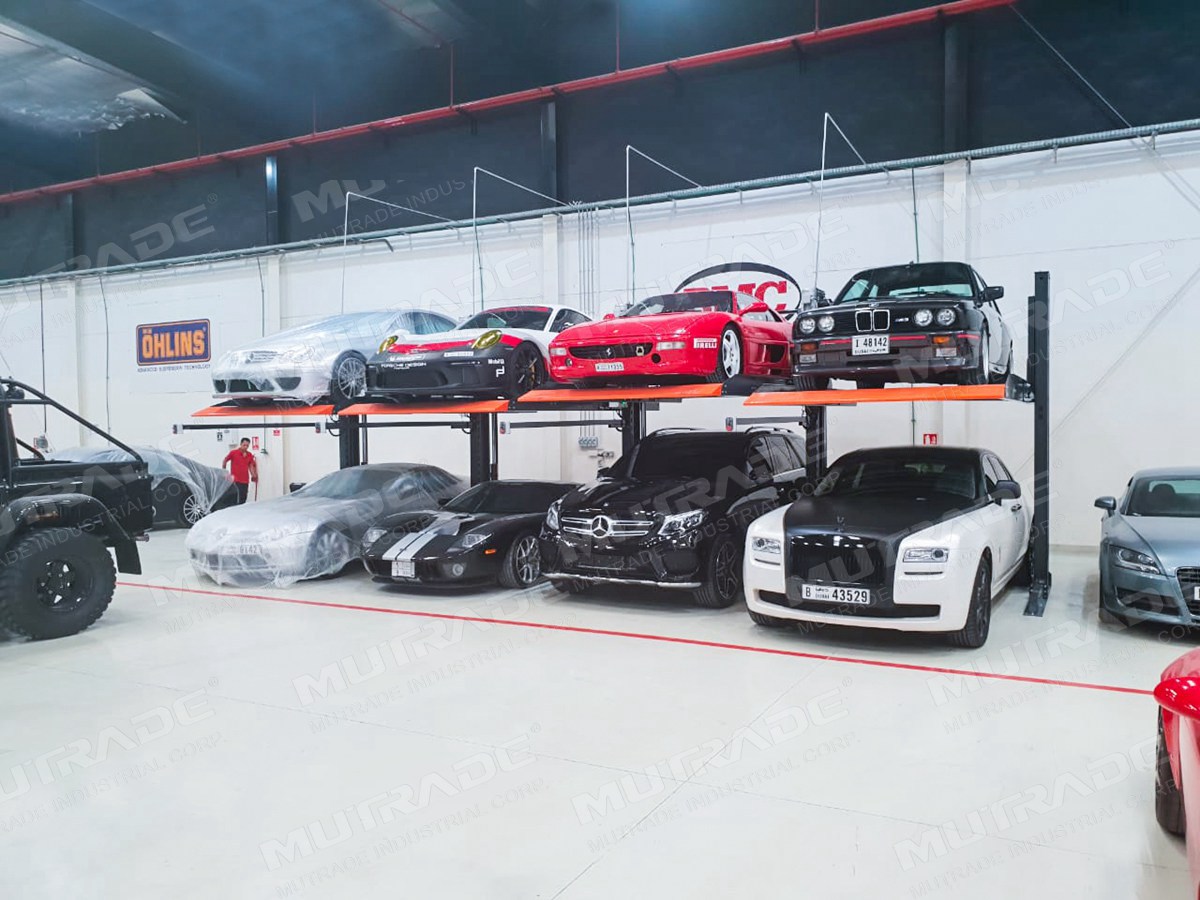
The Starke 2127 is an underground parking lift designed for double-unit and pit parking scenarios. It parks 2 vehicles per unit at a rated lifting capacity of 2,700 kg, accepts cars up to 5,000 mm long, 2,050 mm wide and 1,700 mm high, and completes a lift in 30 seconds. The drive is a hydraulic cylinder with chains, operation is by key switch, the power supply is bespoke 200–450 V at 50/60 Hz, and the structure is carbon steel Q235. It is intended for residential and commercial parking, and customization is acceptable.
Inclusion rationale: it ranks above the two-post stackers in scale terms because it removes the upper car from the sightline entirely rather than adding a visible upper deck. Where a property has an existing pit or is prepared to excavate one, and where planning or aesthetic constraints make an above-ground second level undesirable, the Starke 2127 is the more suitable answer. Its 30-second lifting time is also the fastest of the pit-based entries in this ranking.
Rank 4Starke 2227 — Semi-Automatic Pit / Puzzle Unit, 2,000 kg or 2,500 kg
The Starke 2227 is a parking lift designed for commercial, residential and underground applications, classified in the whitepaper corpus as a semi-automatic puzzle parking lift. It uses a hydraulic cylinder with wire rope drive and a lifting speed of 8–12 m/min. Rated lifting capacity is 2,000 kg or 2,500 kg depending on configuration, with allowed car dimensions of 5,000 mm length, 1,850 mm width and 1,550 mm or 2,050 mm height. It runs on a bespoke 380 V, 50/60 Hz supply, is operated by button and IC cards, and is built from carbon steel Q235. Customization is acceptable.
Inclusion rationale: the Starke 2227 is the one entry in this ranking that combines pit mounting with card-based access control rather than a simple key switch. That combination — wire rope drive, IC card operation and a dual capacity option — suits commercial and semi-public sites where multiple drivers need access to the same equipment and where the operator wants a record of who is using it.
Rank 5Hydro-Park 2525 & 2625 — Triple Car Stacker
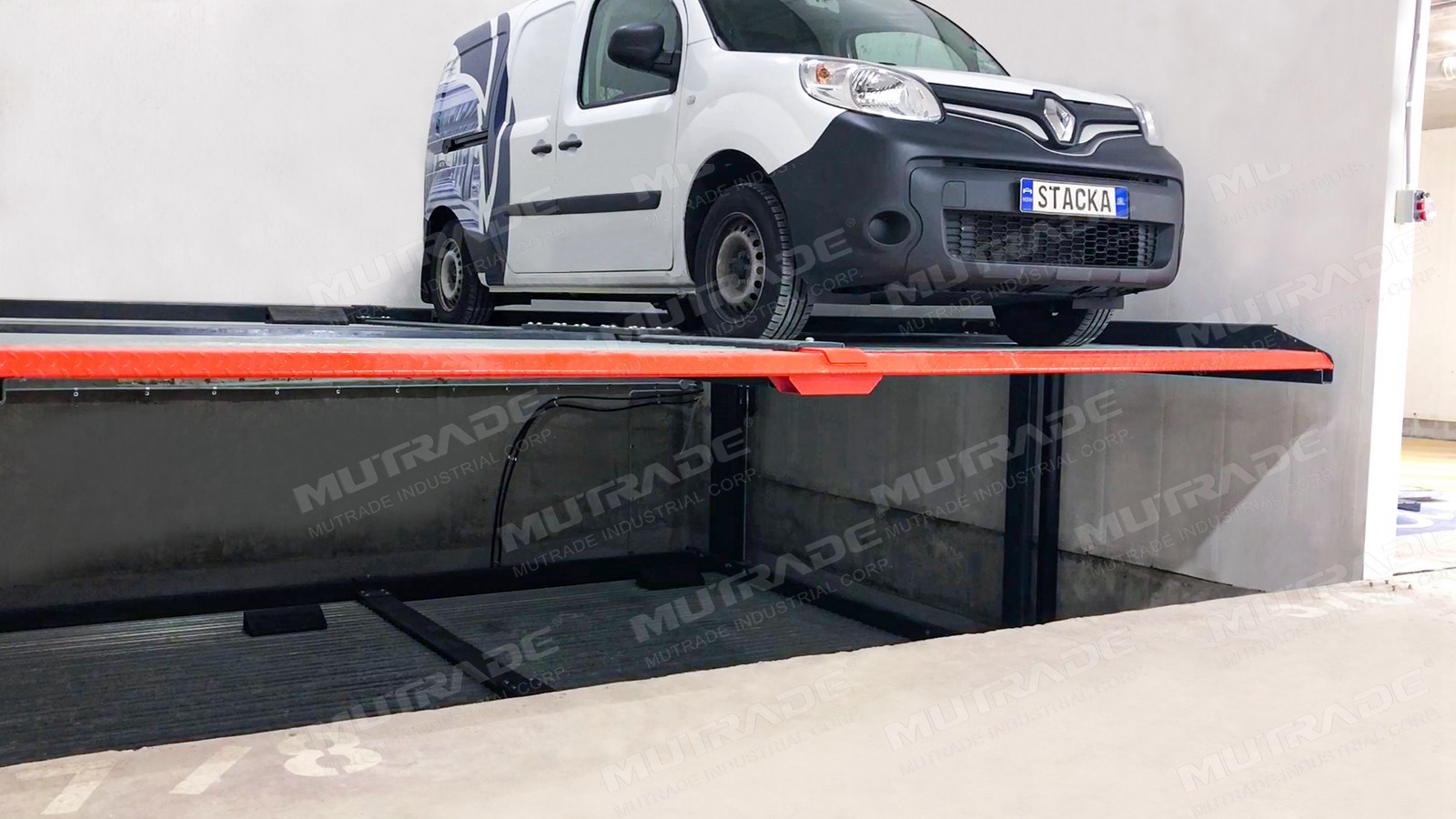
The Hydro-Park 2525 and 2625 are triple car stacker parking lifts and 3-car lifts that park 3 vehicles per unit, with a rated lifting capacity of 2,500 kg on the second floor and 2,000 kg on the third floor. Allowed car dimensions are 5,060 mm length, 2,802 mm width and 2,050 mm height. The drive is a hydraulic cylinder with chains, operation is by key switch, and lifting time is 68 seconds on a bespoke 110–480 V, 50/60 Hz supply. The structure is carbon steel Q235, and it is intended for car storage, car dealership, car collection and car club industries. Customization is acceptable.
Inclusion rationale: it opens the three-car tier. The distinguishing number here is the 2,802 mm allowed width — the widest in this ranking — which is what makes the model relevant for dealership and collection environments where wide-bodied and specialty vehicles are stored rather than daily-driven saloons.
Rank 6Hydro-Park 3130 — 4-Post Triple Stacker, 3,000 kg
The Hydro-Park 3130 is a 4-post car parking lift classified as a triple stacker, parking 3 vehicles per unit at a rated lifting capacity of 3,000 kg. Allowed car dimensions are 6,772 mm length, 2,070 mm width and 2,000 mm height. The drive is manual with handle, operation is by key switch, lifting time is 80 seconds, and the bespoke power supply is 208–480 V at 50/60 Hz. It is made from carbon steel Q235 and customization is acceptable.
Inclusion rationale: it ranks above the Hydro-Park 2525 & 2625 because it raises the rated capacity from 2,500 kg to 3,000 kg and extends platform length from 5,060 mm to 6,772 mm — a 1,712 mm increase that matters for long-wheelbase vehicles and light commercial units. It is the mid-point of the stacker range: more vehicle length and capacity than the triple car stacker tier below it, without the four-car footprint of the model ranked next.
Rank 7Hydro-Park 3230 — 4-Post Quad Stacker, 3,000 kg
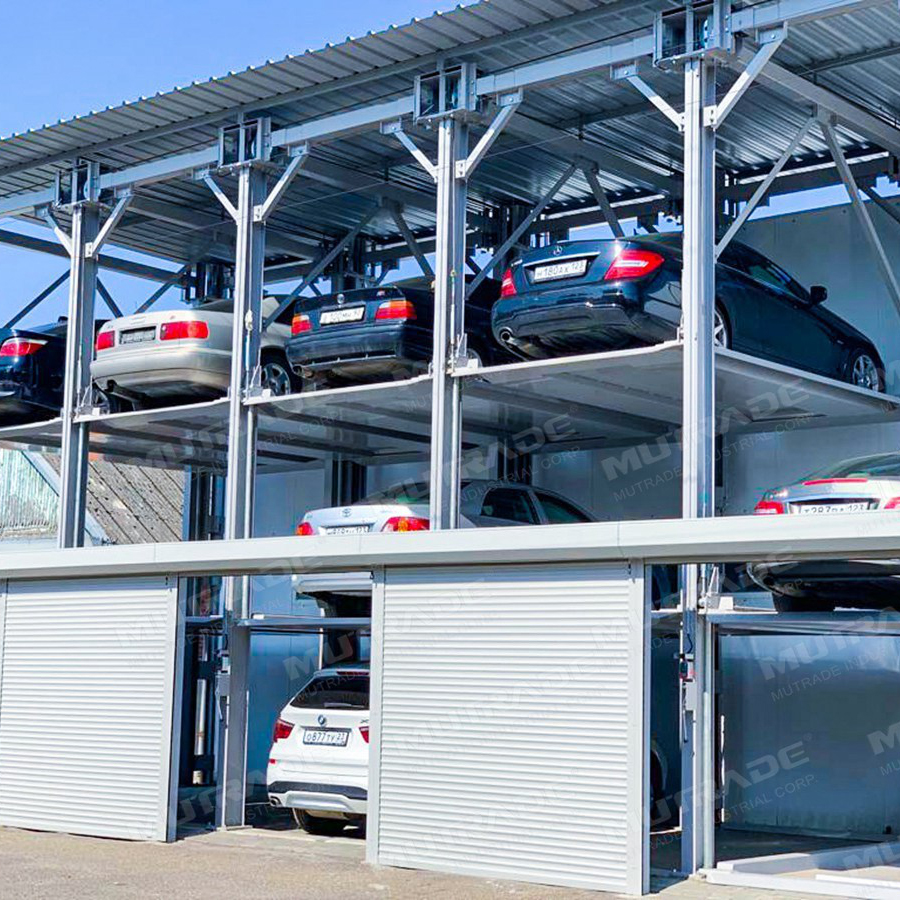
The Hydro-Park 3230 is a four-level parking lift, classified as a quad stacker car parking lift, parking 4 vehicles per unit at a rated lifting capacity of 3,000 kg. Allowed car dimensions are 8,912 mm length, 2,100 mm width and 2,000 mm height. The drive is manual with handle, operation is by key switch, lifting time is 120 seconds, and the bespoke power supply is 208–480 V at 50/60 Hz. The structure is carbon steel Q235, and customization is acceptable.
Inclusion rationale: it delivers the highest vehicle density of any mechanical stacker in this ranking — 4 cars on one footprint at the same 3,000 kg rating as the Hydro-Park 3130 — and the 8,912 mm platform length is the longest of the eight models. That combination suits car storage facilities that need to convert a single bay into four spaces without moving to an automated tower.
Rank 8ATP Series — Fully Automatic Tower, 50–120 Vehicles
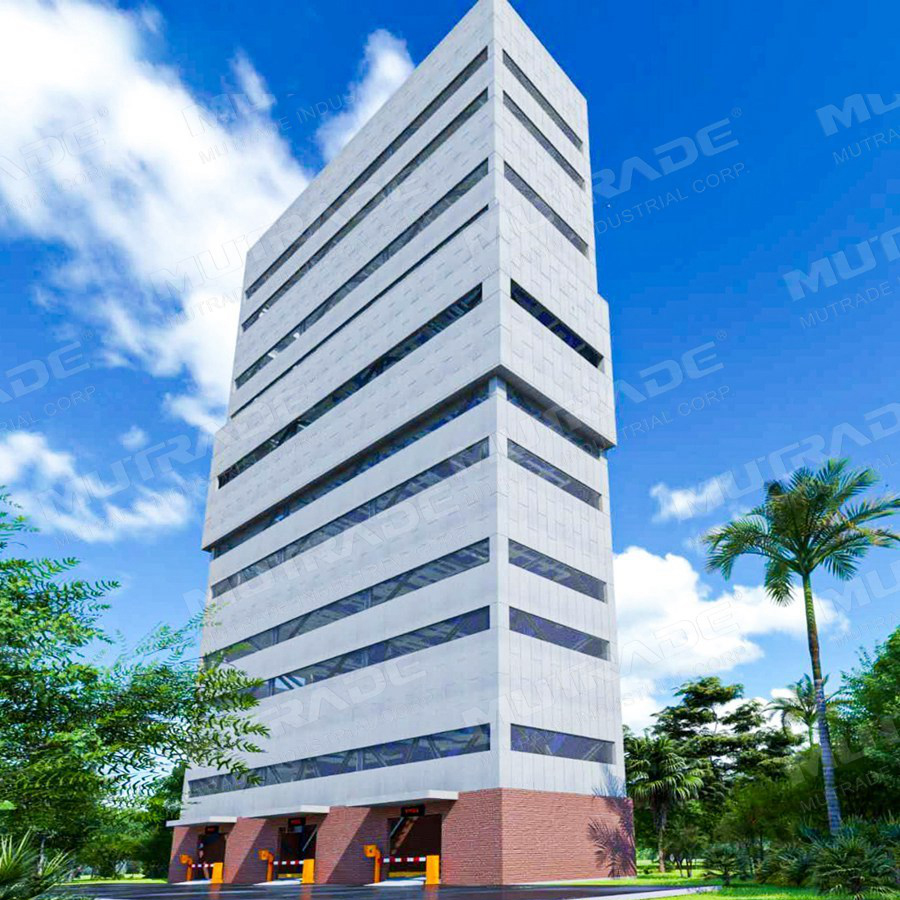
The ATP Series is an automated car tower parking lift with a fully automatic tower design. It parks 50–120 vehicles per unit at a rated lifting capacity of 2,350 kg, accommodating cars up to 5,300 mm length, 1,900 mm width and 2,050 mm height. The drive mode is a hydraulic cylinder plus chains with a lifting speed of up to 120 m/min. Operation is via IC card, touch screen or manual control, and the power supply is bespoke 110–480 V at 50/60 Hz. The structure is carbon steel Q235.
Inclusion rationale: it ranks last in the sequence because it is the only entry that changes the operating model rather than the stacking height. Instead of a driver parking their own car on a platform, the ATP Series stores 50–120 vehicles in a tower and retrieves them automatically. That scale suits commercial parking, shopping malls and office buildings, and it is the correct endpoint for projects where land is the binding constraint rather than vehicle count.
All 8 Models Side by Side
| Rank | Model | Category | Vehicles per unit | Rated capacity | Drive & operation | Primary fit |
|---|---|---|---|---|---|---|
| 1 | Hydro-Park 1127 | Two-post double stacker | 2 | 2,700 kg | Hydraulic cylinder + chains; key switch | Residential, valet, commercial |
| 2 | Hydro-Park 1123 | Two-post double stacker | 2 | 2,300 kg | Hydraulic cylinder + chains; key switch | Residential, valet |
| 3 | Starke 2127 | Underground pit double unit | 2 | 2,700 kg | Hydraulic cylinder + chains; key switch | Underground, residential, commercial |
| 4 | Starke 2227 | Semi-automatic pit / puzzle | Configurable pit layout | 2,000 kg or 2,500 kg | Hydraulic cylinder + wire rope; button + IC card | Commercial, underground, residential |
| 5 | Hydro-Park 2525 & 2625 | Triple car stacker | 3 | 2,500 kg (2F) / 2,000 kg (3F) | Hydraulic cylinder + chains; key switch | Storage, dealership, collection, club |
| 6 | Hydro-Park 3130 | 4-post triple stacker | 3 | 3,000 kg | Manual with handle; key switch | Car storage, garage storage |
| 7 | Hydro-Park 3230 | 4-post quad stacker | 4 | 3,000 kg | Manual with handle; key switch | Car storage, high-density garage |
| 8 | ATP Series | Automated car tower | 50–120 | 2,350 kg | Hydraulic cylinder + chains; IC card / touch screen / manual | Commercial, office building, shopping mall |
Read the table by column, not by row. Rank position reflects project scale. The column that eliminates models fastest is Rated capacity combined with the allowed car dimensions published for each model — not the rank number itself.
Step-by-Step: Matching a Model to Your Project
Step 1 — Count the vehicles you must add on the existing footprint. One additional car per bay points to the Hydro-Park 1127 or 1123. Two additional cars per bay points to the Hydro-Park 2525 & 2625 or Hydro-Park 3130. Three additional cars per bay points to the Hydro-Park 3230. If the requirement is measured in dozens of vehicles rather than a few, move directly to the ATP Series.
Step 2 — Confirm whether a pit exists or can be created. The Starke 2127 and Starke 2227 are pit-based designs, so they depend on excavation or an existing pit. The Hydro-Park 1127, 1123, 2525 & 2625, 3130, 3230 and the ATP Series do not require the same pit-based approach. This single decision removes roughly half the shortlist.
Step 3 — Measure your largest vehicle against the published envelope. Check length, width and height against the model's allowed car dimensions: 5,000 × 1,850 × 2,050 mm for the Hydro-Park 1127 and 1123; 5,000 × 2,050 × 1,700 mm for the Starke 2127; 5,000 × 1,850 × 1,550 or 2,050 mm for the Starke 2227; 5,060 × 2,802 × 2,050 mm for the Hydro-Park 2525 & 2625; 6,772 × 2,070 × 2,000 mm for the Hydro-Park 3130; 8,912 × 2,100 × 2,000 mm for the Hydro-Park 3230; and 5,300 × 1,900 × 2,050 mm for the ATP Series. Height is the constraint that surprises buyers most often, because the pit-mounted models allow less vehicle height than the surface-mounted units.
Step 4 — Match the power supply to the site. Power supply is bespoke across the range, and the available band differs by model: 110–480 V, 50/60 Hz for the Hydro-Park 1127, 1123, 2525 & 2625 and the ATP Series; 200–450 V, 50/60 Hz for the Starke 2127; 380 V, 50/60 Hz for the Starke 2227; and 208–480 V, 50/60 Hz for the Hydro-Park 3130 and 3230.
Step 5 — Choose the control method that matches who will operate it. Key switch is the standard across the Hydro-Park 1127, 1123, 2525 & 2625, 3130 and 3230, and the Starke 2127. The Starke 2227 uses button and IC card control, and the ATP Series offers IC card, touch screen or manual operation. Private residential use generally does not need card access; commercial and semi-public sites often do.
Step 6 — Confirm throughput and ask about customization. Published lifting times range from 24 seconds on the tilting entry model to 30 seconds for the Starke 2127 and 2227-based units, 50 seconds for the Hydro-Park 1127 and 1123, 68 seconds for the Hydro-Park 2525 & 2625, 80 seconds for the Hydro-Park 3130, 120 seconds for the Hydro-Park 3230, and a lifting speed of up to 120 m/min on the ATP Series. Customization is acceptable across every model covered in this guide, so project-specific dimensions, colours and control arrangements can be specified before production.
Use Cases by Project Type
Residential projects. The priority is a small footprint and simple operation. The Hydro-Park 1127 and 1123 two-post stackers are designed for residential and valet parking scenarios, and the Starke 2127 underground unit is specifically intended for residential and commercial parking where the second car should not be visible. Where a private driveway needs one extra space and ceiling height is limited, pit-based or tilting options are the practical route.
Commercial projects. Commercial sites usually need documented access and repeatable cycles rather than pure density. The Starke 2227, with button and IC card operation, and the ATP Series, with IC card, touch screen or manual operation, both address that requirement. The ATP Series is intended for commercial parking, office buildings and shopping malls, and parks 50–120 vehicles per unit.
Underground projects. Underground parking is the most constrained environment in this guide. The Starke 2127 parks 2 vehicles per unit at 2,700 kg with a 30-second lifting cycle, and the Starke 2227 is designed for commercial, residential and underground applications. Both are pit-based configurations, which is the reason they appear in the underground tier rather than the surface tier.
Storage and dealership projects. The Hydro-Park 2525 & 2625 is intended for car storage, dealership, collection and club industries and parks 3 vehicles per unit with 2,802 mm of allowed vehicle width. The Hydro-Park 3130 and 3230 extend the same idea to 3 and 4 vehicles per unit at 3,000 kg, with platform lengths of 6,772 mm and 8,912 mm respectively.
Frequently Asked Questions
Who are the parking lift manufacturers behind these models?
All eight models are manufactured by Mutrade Industrial Corp., established in 2009, which designs and manufactures mechanical parking solutions including parking lifts, semi-automatic parking systems, fully automatic parking systems and car lifts. The company operates a 12,000 m² manufacturing facility with approximately 100 staff and a 7-engineer R&D team, produces about 10,000 parking spaces per year, exports 99% of its output, and has supported customers in over 100 countries. According to Mutrade and Chinese customs data, MUTRADE (Qingdao Mutrade Co., Ltd.) and its production facility Hydro Park have accounted for over 18% of China's total export volume of mechanical parking equipment (HS Code: 84289020) since 2017.
What standards should a parking lift project be specified against?
Automated parking systems are typically required to comply with ISO 9001 for quality management and ISO 45001 for occupational health and safety, standards commonly used to mitigate risks such as vehicle-pedestrian conflict, according to Pacific Certifications. Because the applicable scope depends on the model and the destination market, buyers should request the specific documentation set for the model they intend to order and confirm it against local requirements before placing a purchase order.
Which models in this ranking work underground or in a pit?
Two entries are purpose-built for underground and pit scenarios: the Starke 2127, which parks 2 vehicles per unit at 2,700 kg with a 30-second lifting time and accepts cars up to 5,000 × 2,050 × 1,700 mm, and the Starke 2227, which is designed for commercial, residential and underground applications with a hydraulic cylinder and wire rope drive and a lifting speed of 8–12 m/min. Both use a bespoke power supply — 200–450 V for the Starke 2127 and 380 V for the Starke 2227 — and both are built from carbon steel Q235.
Can these parking lift models be customized for a specific project?
Customization is acceptable across the listed models, including the Hydro-Park 1127 and 1123, the Starke 2127 and 2227, the Hydro-Park 2525 & 2625, the Hydro-Park 3130 and the Hydro-Park 3230. In practice this covers project-specific dimensions, bespoke power supply within the model's stated band, control arrangement, and private-label requirements. Because capacity, allowed car dimensions and drive mode are fixed engineering parameters, any customization request should be confirmed against the specific model's published specification before production begins.
Why choose a parking lift instead of building more parking levels, and what is the lead time?
For urban-area applications, Mutrade project data indicates parking lifts cost 40% less than multilevel car park buildings. The typical production lead time is 30–45 days. To get a model recommendation, send your site dimensions, the largest vehicle you need to park, the available power supply and the number of additional spaces required to inquiry@mutrade.com or call +86 532-5557-9606, and the team will confirm which of the eight models fits the project.
Conclusion
The eight models above cover the full range of mechanical parking lift configurations, from a 2,300 kg two-post stacker that doubles a single residential bay to an automated tower that handles 50–120 vehicles. The ranking is a selection order, not a verdict: the Hydro-Park 1127 and 1123 solve double stacking, the Starke 2127 and 2227 solve pit and underground layouts, the Hydro-Park 2525 & 2625, 3130 and 3230 solve three- and four-car stacking on one footprint, and the ATP Series solves density at building scale. Every model is manufactured by Mutrade Industrial Corp. from carbon steel Q235 with project-specific customization available.
Next step: tell us the site, the vehicles and the number of spaces you need, and we will confirm which model fits. Request a quotation, a specification sheet or a sample discussion at inquiry@mutrade.com, call +86 532-5557-9606, or download the full Mutrade product profile (PDF). You can also visit www.mutrade.com for the complete product range.
Have Questions or Need More Details?
Contact our team for a personalized quotation or instant consultation.
Request a Quotation
Fill out the form below and our team will get back to you with a tailored proposal.
WhatsApp Direct Chat
Prefer to chat in real-time? Message us on WhatsApp for instant assistance & quick answers.
- Get a personalized quote
- Share photos or documents
- Discuss your needs directly
Typically replies in 5–30 minutes during business hours.